
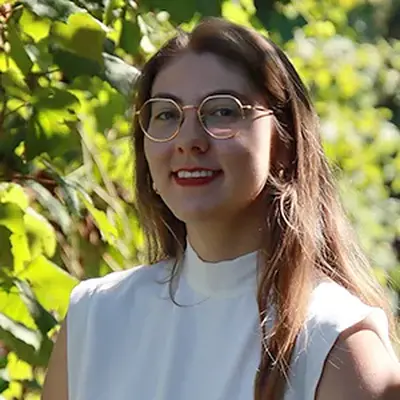
Camille Réau is pursuing a degree in sociology at the Department of Teaching and Research (DER) in the Humanities and Social Sciences (SHS).
In 2023–2024, she is enrolled in the specialized year in research-creation (ARRC), a one-year program at the intersection of the arts, sciences, and technologies. "In Research-Creation, we learn to build bridges between the sciences, research, and the world of art."
The competitive entrance exam is open to everyone, whether you come from the big preparatory schools in Paris or the smaller ones in the provinces (which was my case). It’s hard to sum up ENS Paris-Saclay as being solely about research and teaching—there are so many more opportunities behind its doors.
Portrait
What is your educational background?
After earning my high school diploma in the science track with a specialization in mathematics, I first enrolled in a speech-language pathology preparatory program, during which I realized that I didn’t want to pursue that career. I then switched to a BL preparatory program, which I completed in three years, before enrolling at ENS Paris-Saclay in 2021 in the Department of Humanities and Social Sciences (SHS). The ENS schools were seen as the “holy grail” in prep school, especially in the literary track, where we don’t really aim for other schools (unlike the science tracks, which are more oriented toward engineering schools). In the BL track, we knew that the three schools we were aiming for were ENS Ulm, ENS Paris-Saclay, and ENS Lyon.
I completed my first year in sociology and economics, followed by my M1 in contemporary sociology.
Finally, this year I decided to do the ENS ARRC program to bridge the gap between the fields of science and research and the field of arts and culture, which is where I hope to pursue a career.
Did you know from the start what you wanted to do when you entered ENS Paris-Saclay?
I think I knew mostly what I didn’t want to do, but as for the rest, it was pretty vague.
I really had a passion for literature and culture, and I knew I wanted to do something with them. At first, I conducted research projects in cultural sociology and the sociology of literature for my assignments and thesis, without really knowing where that would lead me.
It was only later, through talking with other students and doing internships, that my plans became clearer.
Which specific year were you in?
I’m currently in the ARRC year, which I first learned about in my freshman year during the back-to-school culture lecture, and I heard about it again later from a few students.
In Research-Creation, we learn to build bridges between science, research, and the art world. The main goal is to carry out Art-Science projects—that is, to make scientific research accessible to the general public, to conduct scientific research through art, or to incorporate scientific research into artistic creation. The year is intended above all to be a journey of discovery: we explore many media and numerous art forms (music, theater, audio documentaries, writing…), and we also had the opportunity to organize a cultural event.
You served as President of the Arts Office (BDA). What did this role bring you?
I served as president of the BDA for one year. I discovered the organization through the InterCulturelles 2022 event, which was organized in Saclay by the Bureau des Arts. I initially handled communications for the event before becoming president a few months later as part of the new leadership team.
The experience was incredibly enriching, especially for me, as I’m interested in pursuing a career in cultural programming and administration. We spent the year organizing cultural outings, concerts, and a trip to a European capital; helping to manage arts clubs; and promoting the arts and culture within the school. Getting so involved in a student organization was key to my integration at ENS, since that’s where I was able to start meeting other students from different departments. I also gained new skills: for example, I had never set up a stage for a concert before!
Being president requires learning how to manage a team and a schedule, having a knack for organization, knowing how to lead meetings, representing the club, engage with the administration and other associations, be diplomatic, come up with new ideas to energize the school, and propose new activities or events for students… It’s an intense and demanding year, but one I found extremely formative.
What do you plan to do in the future?
I’d like to work in cultural programming, with a particular focus on literary and theatrical organizations.
The school broadened my horizons by introducing me to people with backgrounds similar to mine, but above all by allowing me to shape my own path from start to finish… From ENS Paris-Saclay, I take away rich experiences and opportunities I couldn’t have had anywhere else. It also gave me a sense of freedom that I think is rare at other schools. I had enlightening and exciting encounters.
Can you tell us what the School has given you?
The School has broadened my horizons by connecting me with people who share similar backgrounds to mine, but above all by allowing me to shape my own path from start to finish.
We have so many opportunities and resources at our disposal that it’s sometimes hard to keep track of them all and know how to make the most of them. But thanks to the ENS, I was able to do an internship at an embassy, write a thesis on a major French cultural institution with which I had no prior connections, organize a seminar on the sociology of literature, meet with the administration of a theater (La Scène de Recherche, with whom we work closely within the ARRC program), and, more recently, land an internship at one of France’s largest literary festivals, thanks to one of the instructors in the ARRC program.
The possibilities are endless, and I’m fortunate to be supported here by professors and a team deeply committed to their students’ success. I’ve also had the chance to meet students with very diverse and fascinating backgrounds who have helped me find my direction. Whether through my academic experience or my involvement in student organizations.
What I take away from the ENS are enriching experiences and opportunities I wouldn’t have had anywhere else. There’s also a sense of freedom that I think is rare at other schools. Enlightening and exciting encounters.
What advice would you give to students who are hesitant about coming to ENS Paris-Saclay?
Don’t hesitate! The entrance exam is open to everyone, whether you come from major Parisian prep schools or smaller ones in the provinces (which was my case). It’s hard to sum up ENS Paris-Saclay solely in terms of research and teaching—there are so many more possibilities behind its doors.