
The diploma
For students at the École Normale, the program consists of three stages:
- a preparatory year (double bachelor’s degree),
- two years of a research-oriented master’s program,
- one year devoted to supplementary training (preparation for civil service exams, internships, or study abroad).
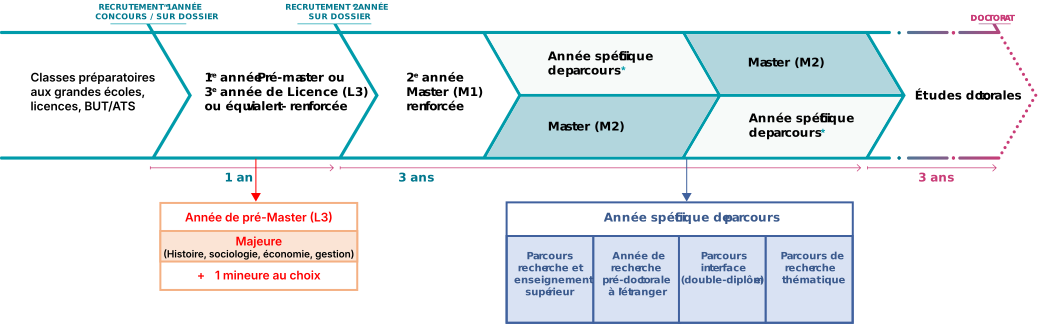
First Year - Bachelor’s Degree (L3)
The DER SHS offers first-year students a multidisciplinary and intensive program, combining its four core disciplines for a total of 80 ECTS credits:
- Economics
- History
- Management
- Sociology
Choice of a Major
Each student must complete a third-year (L3) program (60 ECTS) in a discipline chosen as a “major” over the two semesters of the academic year (from among economics, history, management, and sociology).
Choosing a Minor
Students must also choose a supplementary program in another discipline (for at least 15 ECTS) selected as “minor ” over the two semesters of the academic year (from among economics, history, management, and sociology).
Selection of Electives
In the second semester, students must also take a set of courses and elective courses (one or two electives, totaling at least 5 ECTS) from the DER’s course and elective offerings.
Second Year - Master 1
- As part of the program’s core curriculum, students must complete, in their second year, an enhanced Master 1 program. They then specialize in one of the two disciplines from the track they began in their first year by enrolling in one of the Master’s programs offered by ENS Paris-Saclay.
The 3rd and 4th Years – Master’s 2 and Specialized Track Year
During the third and fourth years, ENS students must complete a research-oriented Master’s 2 program, as well as a specialized track year.
The research-oriented Master’s 2 is primarily designed to prepare students for doctoral studies.
For the specialized track year, students must choose one of the following four tracks:
- “Research and Higher Education” (agrégation)
- "Research and International Affairs"
- "Interface" (dual degree)
- Thematic Research: AI, quantum computing, research-creation, ecological transitions, Normalien engagement.
For more details on the specific year of the track, visit the ENS Paris-Saclay website.